Tuesday, 15 November 2016

HIV and AIDS

Many people (not just kids, but adults, too) don't understand how HIV and AIDS are related, even though they hear these two words used together all the time.

HIV stands for humanimmunodeficiency (say: im-yuh-noh-di-fish-un-see) virus. AIDS stands for acquired immunodeficiency syndrome. HIV is actually the virus that causes the disease AIDS.

HIV Hurts the Immune System

People who are HIV positive have been tested and found to have signs of the human immunodeficiency virus in their blood. HIV destroys part of the immune (say: ih-myoon) system. Specifically, it affects a type of white blood cell called the T lymphocyte (say:lim-foh-site), or T cell. T cells are one type of "fighter" cell in the blood that help the body fight off all kinds of germs and diseases.
After HIV enters the body, it piggybacks onto a T cell and works its way inside of that cell. Once inside, the virus completely takes over the T cell and uses it as a virus-making factory to make a lot of copies of itself. The newly made viruses then leave the T cell and go on to infect and destroy other healthy T cells as they continue to multiply inside the body. T cells invaded by the virus can no longer fight infections properly.
Someone who is infected with the virus is called HIV positive. But it may take years for the virus to damage enough T cells for that person to get sick and develop AIDS. Although the HIV-positive person may feel fine, the virus is silently reproducing itself and destroying T cells.
However, thanks to new medications, someone infected with HIV can stay relatively healthy and symptom-free for many years. These medications are very expensive and not available to everyone in the world.
When the person's immune system has weakened and more of the blood's T cells have been destroyed by the virus, the person can no longer fight off infections. This is when he or she gets very sick. A doctor diagnoses someone with AIDS when the person has a very low number of T cells or shows signs of a serious infection.

How Many People Have HIV/AIDS?

Since the discovery of the virus in 1983, millions of people throughout the world have been infected with HIV. Most are adults, but some kids and teens have HIV, too. In the world today, AIDS remains an epidemic (say: eh-puh-deh-mik), which means that it affects a large number of people and continues to spread rapidly.
Right now, about 37 million people in the world are living with HIV infection or AIDS. About 3 million of those infected are children. In the United States alone, more than 1 million people are living with HIV.

How Is HIV Spread?

HIV infection isn't like a cold or the flu. A kid cannot get HIV by riding a school bus with or visiting the home of someone who has HIV, or by holding that person's hand. HIV is passed only through direct contact with another person's body fluids, such as blood.
The majority of people in North America get infected with HIV by:
  • sexual contact
  • sharing needles or syringes (used to inject drugs or other things) with another person
Other ways of getting HIV:
  • An infected pregnant woman passes it to her unborn child (this can be prevented by treating the mother and child around the time the baby is delivered).
  • A person has a blood transfusion (say: trans-fyoo-zhun). But in North America today, all donated blood is tested for HIV, so the risk of getting HIV that way is less than 1 in a million.

What Are the Symptoms of HIV/AIDS?

It's important to know that you can't tell that someone has HIV just by what he or she looks like. Most people don't feel any different after they are infected with HIV. In fact, infected people often do not experience symptoms for years. Some develop flu-like symptoms a few days to a few weeks after being infected, but these symptoms usually go away after several days.
If untreated, an HIV-positive person will eventually begin to feel sick. The person might begin to have swollen lymph nodes, weight loss, fevers that come and go, infections in the mouth, diarrhea, or he or she might feel tired for no reason all of the time. Eventually, the virus can infect all of the body's organs, including the brain, making it hard for the person to think and remember things.
When a person's T cell count gets very low, the immune system is so weak that many different diseases and infections by other germs can develop. These can be life threatening. For example, people with AIDS often develop pneumonia (say: nu-mo-nyah), which causes bad coughing and breathing problems. Other infections can affect the eyes, the organs of the digestive system, the kidneys, the lungs, and the brain. Some people develop rare kinds of cancers of the skin or immune system.
Most of the children who have HIV got it because their mothers were infected and passed the virus to them before they were born. Babies born with HIV infection may not show any symptoms at first, but if they are not treated, the progression of AIDS is often faster in babies than in adults. Doctors need to watch them closely. Kids who have HIV or AIDS may learn more slowly than healthy kids and tend to start walking and talking later.

How Are HIV/AIDS Diagnosed?

Someone can be infected with HIV without even knowing it. So doctors recommend testing for anyone who might have been exposed to the virus, even if the chance seems very small. Doctors test a person's blood or saliva to find out if he or she is infected with HIV.
People who are HIV positive need to have additional blood tests every so often. The doctor will want to see how many T cells the person has. The lower the T cell count, the weaker the immune system and the greater the risk that the person will get very sick.

How Are HIV/AIDS Treated?

Right now there is no cure for HIV or AIDS, but new medicines can help people live long and healthy lives like people with other chronic diseases (such as diabetes).
Scientists are also researching vaccines that one day might help to prevent HIV infection, but it's a very tough assignment and no one knows when these vaccines might become available.

Can HIV/AIDS Be Prevented?

People can help stop the spread of HIV by not touching another person's body fluids, using latex condoms during sex, and not sharing needles or syringes.
Health care workers (such as doctors, nurses, and dentists) help prevent the spread of HIV by not touching their patient's body fluids. They take special steps that include wearing gloves, protective clothing, and even goggles for their eyes.
Hospitals have strict procedures for handling samples of blood and other body fluids to prevent others from coming in contact with HIV.

Living With HIV/AIDS

New drugs make it possible for people who are HIV positive to live for years without getting AIDS. They can work or go to school, make friends, hang out, and do all of the things other people can do. They will have to take certain medicines every day and see their doctors pretty often, and they may get sick more than other people do because their immune systems are more fragile.
Even though they may look OK, people who are HIV positive may sometimes feel scared, angry, unhappy, or depressed. They may feel afraid that the people at work or school, or their friends or family could find out and start treating them differently. If you know someone who is HIV positive, treat him or her just like any other friend.

Hope for an HIV-Free Future

Maybe one day, with time and research, a cure for HIV infection will be found and AIDS will no longer exist. Until then, the smartest thing to do is to know the facts and avoid putting yourself at risk.
If you have more questions about HIV or AIDS, talk to an adult you trust — a parent, doctor, school nurse, or guidance counselor. Don't depend only on your friends for information about HIV and AIDS because they may not know all the right answers.

Hepatitis

It's sneaky, it's silent, and it can permanently harm your liver. It's calledhepatitis (say: heh-puh-TYE-tus). Some people have hepatitis for many years without knowing it and then discover they have liver damage because of it.
So let's find out more about hepatitis and how to prevent it.

Life of a Liver

Nonstop, 24 hours a day, your liver (an internal organ on the upper right side of your abdomen) does many tasks to keep your body running smoothly:
  • It's like a vacuum! It cleans out toxins (poisons) from your blood.
  • It's like a warehouse! It stores vitamins and minerals and makes sure your body gets the right amounts.
  • It's like a bodybuilder! It produces the right amount of amino acids to build strong, healthy muscles.
  • It's like a gas station! It keeps your body fueled up with just the right amount of glucose (sugar).
  • It's like a meter! It helps regulate the levels of medicine you are taking. (Before some medicines can work, the liver has to start them up.) It also regulates hormones in your body.
  • It's like a factory! It produces an important digestive liquid called bile.

What Is Hepatitis?

Hepatitis is an inflammation (say: in-fluh-MAY-shun) — a kind of irritation — or infection of the liver. If the liver is affected by or gets scarred from inflammation or infection, it can't effectively do all of its jobs.
There are different ways you can get hepatitis. The two most common forms are:
  1. Toxic hepatitis: This can happen if someone drinks a lot of alcohol, takes certain illegal drugs or medicines, or is exposed to poisons.
  2. Viral hepatitis: There are lots of hepatitis viruses — from hepatitis A virus (hep A, for short) to hepatitis G. Though the viruses differ, they have one thing in common: They cause infection and inflammation that is harmful to liver cells.
We'

Hepatitis A

For kids, hep A is the most common type of hepatitis to get. The virus lives in poop (feces) from people who have the infection. That's why it's so important to wash your hands before eating and after going to the bathroom. If you don't, and then go make yourself a sandwich, hep A virus might end up on your food, and then in you!
Vegetables, fruits, and shellfish (such as shrimp and lobster) also can carry hepatitis if they were harvested in contaminated water or in unsanitary conditions. Hepatitis A affects people for a short time, and when they recover, it does not come back.

How to Prevent Hepatitis A

The following will help keep people safe from hepatitis A:
  • regular hand washing, especially after going to the bathroom or diapering a baby, and before eating
  • washing fruits and vegetables before eating them
  • not eating raw shellfish, such as raw oysters
  • getting the vaccine for hep A
Getting vaccinated helps a person's body make antibodies that protect against hepatitis infection. The hepatitis A vaccine is now given to all kids when they're between 1 and 2 years old, and to people who are traveling to countries where the virus could get into the food and water supply. The vaccine is also recommended for kids who have blood clotting problems or chronic liver disease.

Hepatitis B and Hepatitis C

Although hep A is a short-term illness that goes away completely, hep B and C can turn into serious long-term illnesses for some people. Teens and young adults are most at risk for getting these two viruses. Today, all babies get vaccinated against the hep B virus, but there isn't a vaccine for hep C yet.
Hep B and C get passed from person to person the same ways that HIV does — through direct contact with infected body fluids. Hepatitis B and C are even more easily passed in fluids and needles than HIV. This can happen through sexual contact and by sharing needles (used to inject illegal drugs) that have been contaminated with infected blood. Even when infected people don't have any symptoms, they can still pass the disease on to others.
Sometimes mothers with hep B or C pass the virus along to their babies when they're born. Hep B and C also can get passed in ways you might not expect — such as getting a manicure or pedicure with unsterilized nail clippers or other dirty instruments. Getting a tattoo, if dirty needles are used, is another way someone can get hep B or C.

Signs and Symptoms of Hepatitis

Some people with hepatitis show no signs of having the disease, but others may have these symptoms:
  • tiredness without another reason
  • flu-like symptoms — throwing up, feeling hot, etc.
  • yellowing of skin and whites of eyes
  • belly pain (especially on the upper right side)
  • dark brown pee
  • light-colored stools (poop)
  • itchiness with no rash
  • poor appetite for days in a row or weight loss
A doctor who suspects someone may have hepatitis may ask questions like these:
  • Has the person been around anyone who works in health care or childcare?
  • Did the person stick himself or herself with a dirty needle or get a tattoo with a dirty needle?
  • Did the person have contact with the bodily fluids of someone who has hepatitis?
  • Did the person have a blood transfusion as a baby?
  • Have any of the person's family members had hepatitis?
  • Could the person have eaten food that was contaminated with hepatitis A?
The doctor can order a blood test to see if someone has hepatitis and which type, then help the person get the right care.

Living With Hepatitis

Someone who has hepatitis will need to drink enough fluids, eat healthy foods, and get rest. The person's family members may need to get hepatitis vaccines, if they haven't already.
Later on, the person will get follow-up blood tests. Often the blood tests will show that the person no longer has hepatitis. Sometimes, the blood tests may show that someone is now a carrier of hepatitis — he or she won't have hepatitis symptoms, but could pass the infection to other people.
Sometimes, blood tests will continue to show that some people still have hep B or C, which means they may have chronic or long-term hepatitis. If so, they will need to eat healthy foods and take very good care of themselves by getting rest and visiting the doctor regularly. In some cases, someone with chronic hepatitis may get special medicine for the condition.
We hope that this heads-up on hepatitis will help you stay safe. It may sound funny, but you can love your liver by washing your hands and making smart choices!

Wednesday, 9 November 2016

Malaria

Laboratory Tests

Testing is performed to help diagnose malaria, to monitor for relapses, and to determine drug susceptibility of the parasite 
causing the infection.
Thick and thin blood smears
Diagnosis of malaria involves performing blood smears. For a blood smear, a drop of blood is applied to and spread onto a glass slide. It is then treated with a special stain and examined under a microscope for the morphology of infected blood cells and the parasite. Typically, two thick smears and two thin smears are prepared. These tests are currently the "gold standard" for malaria detection and identification. They require examination by a trained and experienced laboratorian.
The number of malaria parasites present in the blood at a given time fluctuates. Therefore, if no parasites are seen on the initial set of smears and the health practitioner still suspects malaria, then additional blood samples will be obtained to be tested. The samples may be collected at 8 to 12 hour intervals over 2 to 3 days to increase the probability of detecting the parasites. It is advantageous if the sample collection coincides with the appearance of signs and symptoms as this is the time that the parasites will most likely be detected in the blood.
Thick smears are a more sensitive test for malaria infection. A greater volume of blood is examined under the microscope and the parasites are therefore more likely to be seen. Thin smears have fewer blood cells present and allow identification of the type of Plasmodium species causing the infection. The number of infected red blood cells can also be calculated to determine the degree to which a person is infected (parasite load). This information is essential for proper treatment.
Rapid diagnostic tests (antigen testing)
When microscopy is not readily available, rapid diagnostic tests may be used instead of blood smears. These tests detect malaria antigens (proteins) in a sample of a person's blood (usually taken with a fingerstick) and indicate a positive result by a color change on the testing strip. They are sometimes called "dipstick" tests.
Different rapid diagnostic tests are available, and they have varying capabilities in what they detect. For example, some rapid tests may detect all four common species (P. falciparumP. vivaxP. ovaleP. malariae) but do not distinguish between them. Others are combination tests that can detect all four common species and will identify P. falciparum specifically if it is present. The type of rapid test used is dependent on the patient population and the goals of providing a rapid test result.
The U.S. Food and Drug Administration (FDA) has approved a rapid diagnostic test for malaria. It is approved for use by hospital and reference laboratories, but not for doctors' offices or home testing. This rapid test may allow for faster diagnosis and treatment. However, it is recommended that positive results be followed with blood smears for confirmation and to determine the extent of infection.
Molecular tests (Polymerase chain reaction, PCR)
The polymerase chain reaction is a laboratory method that amplifies the parasite's DNA and allows detection and identification of the Plasmodium species. This test can be used to confirm the diagnosis in laboratories where there is a lack of training and experience in the microscopic examination for malaria. It can also be used to determine the Plasmodium species if the results of a blood smear are unclear. Likewise, it is useful for cases in which the number of malaria parasites in the blood is low or when there are different types causing the infection (mixed) and examination using a microscope may be less accurate. The cost of these molecular testing techniques limits their use in many regions where malaria is endemic.
Antibody tests (serology)
Serology tests detect antibodies in the blood that are produced by the body in response to a malaria infection. They cannot diagnose an acute infection but help determine if a person was previously exposed. These tests are not routinely used in the U.S. since a diagnosis can be made sooner by detecting the parasite under the microscope or its DNA instead of waiting for an immune response to develop weeks later.
Susceptibility testing
Some malarial parasites have become resistant to the drugs commonly used to treat the infections. Some specialized laboratories can test the parasites from an infected person to determine their drug susceptibility. This can be done either by growing the parasites in the presence of increasing amounts of the drug and observing the effect of the drug on the parasite or by testing the DNA of the parasite to detect markers that indicate resistance. This latter method is still being evaluated.

Widal Test : Principle, Procedure, Result Interpretation and Limitations

Salmonella typhi and Salmonella paratyphi A, B and C cause enteric fever (typhoid and paratyphoid) in human. Laboratory diagnosis of enteric fever includes Blood culture, Stool Culture and Serological test. Widal test is a common agglutination test employed in the serological diagnosis of enteric fever. This test was developed by Georges Ferdinand Widal in 1896 and helps to detect presence of salmonella antibodies in a patient’s serum.

PRINCIPLE OF WIDAL TEST

salmonella-antigensPatients infected with Salmonella produce antibodies against the antigens of the organism. Antibodies in serum, produced in response to exposure to Salmonella organisms will agglutinate bacterial suspension which carries homologous antigens. This forms the basis of Widal test.

The organisms causing enteric fever possesses two major antigens namely somatic antigen (O) and a flagellar antigen (H) along with another surface antigen, Vi. During infection with typhoid or paratyphoid bacilli, antibodies against flagellar antigen of S. typhi (H), S. paratyphi A (AH), S. paratyphi B (BH) and Somatic Antigen of S.typhi (O) usually become detectable in blood, 6 days after the onset of infection.
Those antigens specifically prepared from organism are mixed with patient’s serum to detect the presence of antibodies. Positive result is indicated by the presence of agglutination Absence of agglutination indicates a negative result. The paratyphoid O antigens are not employed as they cross react with the typhoid O antigen. If agglutination occurs with O antigen then it is considered positive for Salmonella typhi. If agglutination occurs in A or B antigen then it is confirmed as positive for Salmonella paratyphi. Agglutination will occur in H antigen for all the cases of antigens like O, A, and B.

PREPARATION OF ANTIGENS

Antigen suspensions may be prepared from suitable stock cultures in the laboratory. But generally commercially prepared suspensions are used.
  • Salmonella typhi is used to prepare S. typhi O and S. typhi H antigens.
  • O antigens for S. paratyphi A and S. paratyphi B are not taken as they cross-react with S.typhi O antigen.
  • H antigen suspension is prepared by treating overnight broth culture or saline suspension of Salmonella with 0.1% formalin.
  • For preparing O antigen suspension, Salmonella are grown on phenol agar (1:800) to inhibit flagella. The growth is then emulsified in small volume of saline, mixed with 20 times its volume of alcohol, heated at 40°C to 50°C for 30 minutes and centrifuged.
  • The antigens are treated with chloroform (preservative) and appropriate dyes are added for easy identification of antigens.

PROCEDURE OF WIDAL TEST

The Widal test can be conducted in two ways :
  • Slide agglutination Widal test
    1. Qualitative Slide Test
    2. Quantitative Slide Test
  • Tube agglutination Widal test
Tube agglutination has more accuracy as compared to the slide agglutination technique. However, A slide widal test is more popular among diagnostic laboratories as it gives rapid results.

Qualitative Slide Test

Procedure :

  1. Bring all reagents to room temperature and mix well.
  2. Add 1 drop of test sample (25µl) into each reaction circle labeled as O, H, AH, BH according to given antigen solution.
  3. Add 1 drop of positive control (25µl) into the circle marked as PC and 1 drop of negative control (25µl) into the reaction circle marked as NC.
  4. Add antigen solutions of Salmonella typhi ‘O’, Salmonella typhi ‘H’, Salmonella paratyphi ‘AH’ and Salmonella paratyphi ‘BH’ to circles labeled as O, H, AH, BH respectively in which test samples has been added.
  5. Mix it thoroughly with the aid of applicator stick and rotate the slide gently.
  6. Observe for agglutination.

Interpretation :

  • Positive Test : Agglutination within a minute
  • Negative Test : No agglutination

Quantitative Slide Test

This is performed for the samples which showed positive agglutination during qualitative test.

Procedure :

  1. Bring all reagents to room temperature and mix well.
  2. Dispense one drop of saline into the first reaction circle and then place 5, 10, 20, 40, 80 ul of the test sample on the remaining circles.
  3. Add a drop of the antigen, which showed agglutination with the test sample in the screening (qualitative) method, to each circle.
  4. Mix the contents of each circle with the aid of applicator stick and rotate the slide gently.
  5. Observe for agglutination.

Interpretation :

The antibody titre of the test sample is its highest dilution that gives a visible agglutination. 80 µl corresponds to 1 in 20 dilution, 40 µl to 1 in 40, 20 µl to 1 in 80, 10 µl to 1 in 160 and 5 µl corresponds to 1 in 320 titre. Agglutinin titre greater than 1:80 is considered as significant infection and low titres indicate absence of infection.

Quantitaive Tube Test

Procedure :

  1. Bring all reagents to room temperature and mix well.
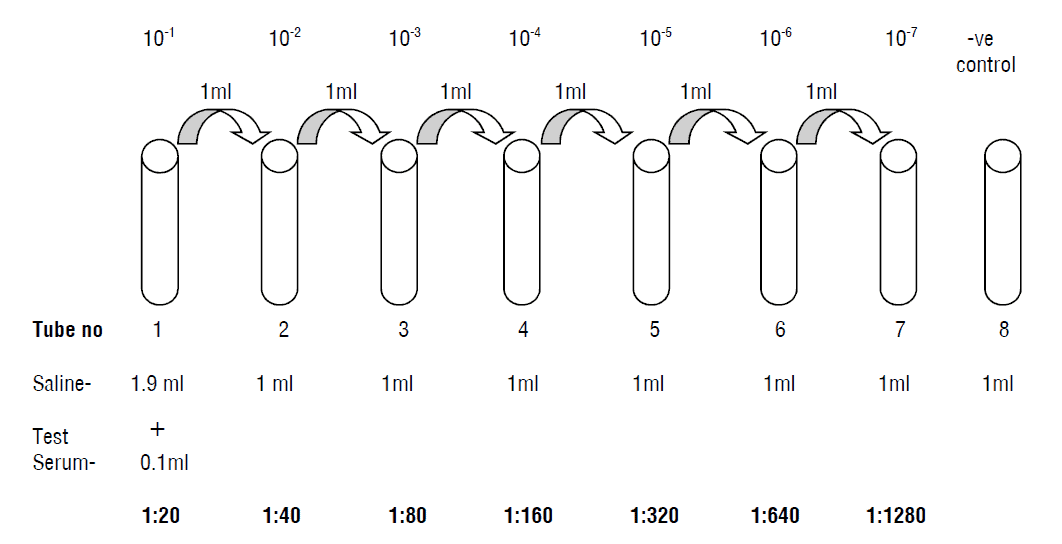
  2. Prepare 4 sets of test tubes for individual antigen. Each set contains 1- 8 tubes.
  3. Add 1.9 ml of 0.85% sterile saline to tube no. 1 of each antigen set.
  4. To tube no. 2-8 of all sets add 1 ml of physiological saline.
  5. To tube No. 1 of all sets add 0.1 ml of test sample to be tested and mix well.
  6. Transfer 1 ml of the diluted serum sample from tube No. 1 to tube No. 2 and mix well.
  7. Transfer 1 ml of the diluted serum sample from tube No. 2 to tube No. 3 and mix well. Continue this serial dilution till tube No. 7 in each set of antigen.
  8. Discard 1.0 ml of the diluted serum from tube No.7 of each set.
  9. So the dilutions of the serum sample from tube No. 1 to 7 respectively in each antigen set are 1:20, 1:40,1:80, 1:160, 1: 320, 1:640, 1: 1280.
  10. Tube no. 8 is negative control with 0.85% sterile saline.
    widal test
  11. To one set i.e. from tube no.1- 8 add 50 µl of Salmonella typhi ‘O’ antigen.
  12. In second set i.e. from tube no.1- 8 add 50 µl of Salmonella typhi ‘H’ antigen.
  13. Respectively for third and fourth sets, add Salmonella paratyphi ‘AH’ and Salmonella paratyphi ‘BH’ to all tubes from 1-8.
  14. Mix well, cover and incubate these tubes overnight at 37 degree Celcius (approximately 18 hours).
  15. After incubation dislodge the sediment and observe for agglutination.

Interpretaton :

The antibody titre of the test sample is its highest dilution that gives a visible agglutination. Agglutinin titre greater than 1:80 is considered as significant infection and low titres indicate absence of infection.

LIMITATIONS OF WIDAL TEST

  1. Tests done within 7 days of illness and after 4 weeks are usually negative.
  2. The local titre of the place should be known for the results interpreted correctly.
  3. This test (Quantitative) is highly time consumable.
  4. Previous typhoid vaccination may contribute to elevated agglutinins in the non-infected population.
  5. Other infections of non-enteric salmonella infection such as Typhus, Immunological disorders, chronic liver disease may cause false positive reaction.
  6. Cross reaction between malaria parasites and salmonella antigens may cause false positive Widal agglutination test

Tuesday, 1 November 2016

Venereal Disease Research Laboratory

The VDRL test is a screening test for syphilis. It measures substances (proteins), called antibodies, that your body may produce if you have come in contact with the bacteria that cause syphilis.
How the Test is Performed.
How the Test is Performed has been expanded.
The test is most often done using a blood sample. It can also be done using a sample of spinal fluid. This article discusses the blood test.
A blood sample is needed.
How the Test will Feel.
How the Test will Feel has been expanded.
When the needle is inserted to draw blood, some people may feel moderate pain. Others feel only a prick or stinging. Afterward, there may be some throbbing or a slight bruise. This soon goes away.
Why the Test is Performed.
Why the Test is Performed has been expanded.
This test is used to screen for syphilis. The bacteria that cause syphilis is called Treponema pallidum.
Your health care provider may order this test if you have signs and symptoms of a sexually transmitted illness (STI).
Syphilis screening is a routine part of prenatal care during pregnancy. Several states also require screening for syphilis prior to obtaining a marriage license.
This test is similar to the newer rapid plasma reagin (RPR) test.
Normal Results.
Normal Results has been expanded.
A negative test is normal. It means that no antibodies to syphilis have been seen in your blood sample.
The screening test is most likely to be positive in the secondary and latent stages of syphilis. This test may give a false-negative result during early- and late-stage syphilis. This test must be confirmed with another blood test to make the diagnosis of syphilis.
Normal value ranges may vary slightly among different laboratories. Some labs use different measurements or test different samples. Talk to your doctor about the meaning of your specific test results.
What Abnormal Results Mean.
What Abnormal Results Mean has been expanded.
A positive test result may mean you have syphilis. If the test is positive, the next step is to confirm the results with an FTA-ABS test, which is a more specific syphilis test.
The VDRL test's ability to detect syphilis depends on the stage of the disease. The test's sensitivity to detect syphilis nears 100% during the middle stages; it is less sensitive during the earlier and later stages.
Some conditions may cause a false-positive test, including:
HIV
Lyme disease
Certain types of pneumonia
Malaria
Systemic lupus erythematosus
The body does not always produce antibodies specifically in response to the syphilis bacteria, so this test is not always accurate.
Risks.
Risks has been expanded.
Veins and arteries vary in size from one person to another and from one side of the body to the other. Obtaining a blood sample from some people may be more difficult than from others.
Other risks associated with having blood drawn are slight, but may include:
Excessive bleeding
Fainting or feeling lightheaded
Hematoma (blood accumulating under the skin)
Infection (a slight risk any time the skin is broken)